



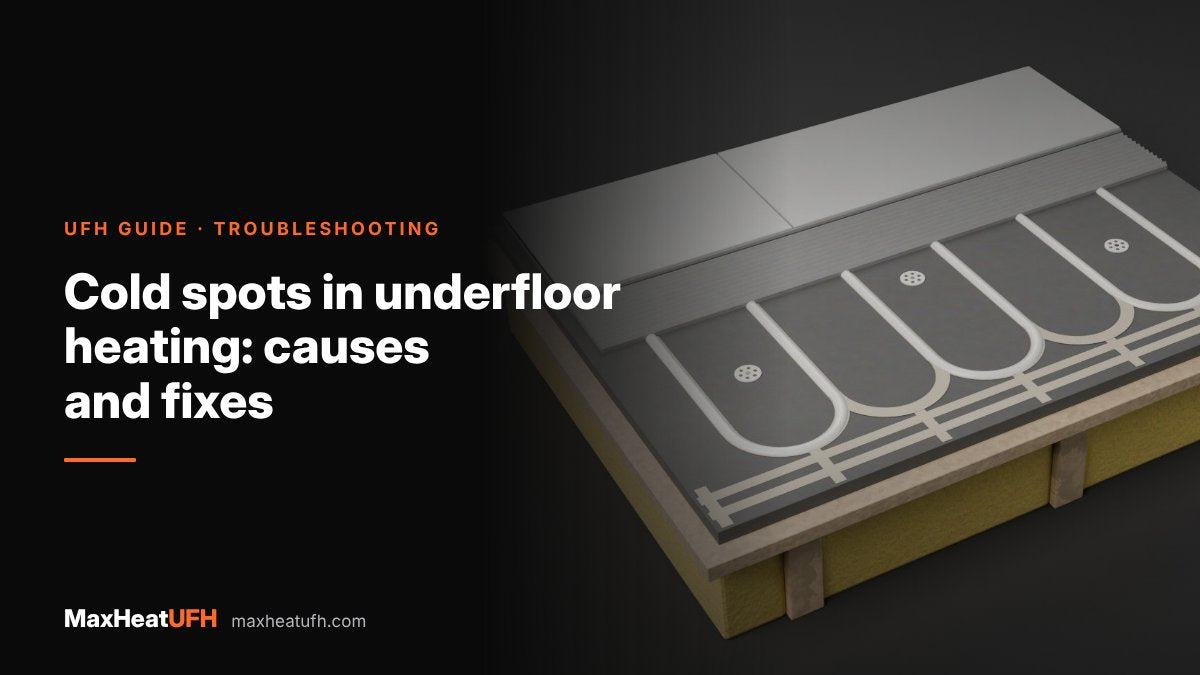
Cold spots in underfloor heating: causes and fixes
How to diagnose a cold patch in underfloor heating: normal edge bands, air in loops, balancing, stuck actuators, rugs and furniture, missing pipe and electric cable faults, with fixes for each.
Short answer: A cold spot in underfloor heating usually means air in the loop, an unbalanced manifold, a stuck actuator, or something sitting on the floor trapping the heat. A cool band right at the wall is normal: pipes are kept at least 50mm from walls and 200mm from chimneys under EN 1264-4, so the floor edge is never heated. Work out first whether a whole loop is cold or just a patch within a warm room, because the causes are different.
Underfloor heating warms the whole slab or deck, so a genuinely cold patch always has a reason: either no hot water (or cable) is reaching that part of the floor, or the heat is there but cannot get out. The good news is that most causes are at the manifold, not under the floor, and you can diagnose them without lifting anything.
This guide works through the causes in the order worth checking: normal edges first, then air, balance, actuators and furniture, and finally the rarer design and damage problems. If an entire room is cold rather than a patch, start with our guide to one loop cold instead.
Is a cold strip along the wall normal?
Yes. Heating pipe is deliberately kept away from the room edge: EN 1264-4 specifies at least 50mm clearance from walls and other vertical construction, and 200mm from chimneys and open fireplaces. Add the edge insulation strip and the first pipe run can sit 100mm or more off the skirting, so a band of floor around the perimeter is simply unheated.
You will feel it most on hard floors in winter. It is not a fault and needs no fix. The same applies in front of fireplaces and around soil pipes and door frames, where the installer had to route around an obstacle.
Wide stripes of warm and cool across the middle of the floor are different: that is the pipe spacing showing through a thin floor build-up, and a thicker screed or a foil heat-spreading layer is what evens it out.
Could air in the system be causing the cold spot?
Air is the most common cause of a loop that is warm near the manifold and cold further round. Air collects at the highest point of a loop and sits there as a pocket the water must push past. Flow drops, the far end of the loop runs cool, and the floor above it shows a cold area.
Signs that point to air:
- The flow meter for that loop reads lower than its neighbours, or flickers.
- You hear gurgling or ticking from the manifold or floor when the pump runs.
- The cold area moved or appeared after the system was drained, topped up or altered.
- The return pipe for that loop at the manifold is much cooler than the others.
The fix is to purge the loop properly: isolate the other loops and push water through the affected one until it runs clear of bubbles. The step-by-step is in our guide to bleeding air out of underfloor heating.
Do the loops need balancing?
If the cold area lines up with one room or one long loop, and the floor near the manifold end of that loop is warm, the loop may simply be getting less than its share of flow. Water takes the easiest path, so short loops steal flow from long ones until each loop is restricted to its design rate.
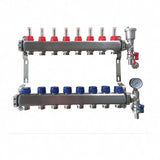
Check the flow meters on the manifold with every zone calling: each loop should hold the rate the design gave it, with longer loops set to higher rates, not lower. A loop showing well below its neighbours while its actuator is open is the one to adjust. One manufacturer's planning guidance designs rooms around a flow-return spread of only a few degrees; a loop whose return comes back much cooler than the rest is running too little flow.
Balancing is a screwdriver job at the manifold, covered step by step, flow meter settings included, in balancing underfloor heating loops.
Is an actuator or the wiring at fault?
If the whole area served by one loop is cold and its flow meter reads zero, the valve for that loop is probably not opening. Each loop's return port carries a thermal actuator that opens when its thermostat calls. They fail in two boring ways: the actuator itself sticks or burns out, or the wiring centre never sends it power.
- Look at the actuator. Most show an indicator band or raised cap when open. With the zone calling for 10 minutes or more, an actuator that has not lifted is suspect.
- Swap the test. Unscrew the actuator (they are hand-tight collars) and see if flow starts with it off. If it does, the valve pin underneath may also be stuck down: press it gently to check it springs back.
- Check the wiring centre. A zone LED that never lights means the fault is upstream, at the thermostat or wiring, not the actuator.
Replacement 2-wire actuators fit in minutes. The full fault tree is in actuator and zone valve faults.
Can rugs and furniture cause cold spots?
Yes, in both directions. A thick rug, a mattress on the floor, a beanbag or a flat-bottomed piece of furniture insulates the floor beneath it. The covered area runs hotter under the obstruction while the room receives less heat, and the floor around it can feel cooler because the room thermostat is satisfied by less output. When the rug is lifted, the patch beneath feels hot and the rest relatively cold.
Leave an air gap under furniture where you can, use furniture on legs over heated areas, and keep rugs off floors that were designed without them. Our guide to rugs and furniture on UFH covers tog limits and what is safe.
What if the pipes were never laid in that area?
Sometimes the cold spot is cold because there is no pipe under it. Common design gaps: under kitchen units and islands, where a bath or shower tray sits, where the installer dodged a soil pipe, or a corner the loop simply never reached. In an extension, the strip where new floor meets old is often pipe-free on both sides.
You can map the pipework without lifting the floor using a thermal imaging camera: run the heating from cold and the pipe pattern shows through in minutes, including any bare areas. See finding UFH pipes with thermal imaging.
If an area genuinely has no pipe, the honest options are to live with it, add a small electric mat there when the floor covering is next replaced, or improve the heat path (a thinner, lower-tog covering spreads warmth further sideways). There is no way to add pipe to a finished screed without opening it.
Why does a brand-new system have cold patches?
Patience, usually. A freshly screeded floor holds a lot of water, and manufacturers require a gentle first heat-up: one UK maker specifies waiting at least 21 days after a cement screed is laid, then running flow at 20 to 25°C for at least 3 days before stepping up to the design temperature for another 4. During those first days the slab heats unevenly as moisture dries out, and patchy warmth is normal.
New systems also still carry air from filling, and the loops may not have been balanced yet. Commission in this order: purge, pressure-check, balance, then the staged first heat-up. Our commissioning guide walks through it.
What causes cold spots in electric underfloor heating?
A cold section of an electric mat or cable floor usually means part of the element is not heating: a damaged cable, a poorly made joint, or two mats wired so that one is dead. A floor that is warm in one half and cold in the other, with the thermostat showing normal operation, points to a second mat not connected. A single sharp cold line can be a cable cut during flooring work.
Diagnosis is electrical, by resistance and insulation tests against the mat's rated figures, and must be done by a qualified electrician to BS 7671. Damaged cables can often be repaired at a single point once located. Start with electric UFH fault finding.
Free design tool: planning a new floor instead of fixing one? Design your UFH system yourself in 3 minutes with MaxHeatUFH ProLoop and get an instant quick design and quote. Start your design
Frequently asked questions
Why is one area of my underfloor heating cold?
Most often: air in that loop, the loop getting too little flow, a stuck actuator, or a rug or piece of furniture trapping the heat. A cool band at the wall edge is normal, because pipes are kept at least 50mm clear of walls.
How do I find out where my UFH pipes run?
Warm the floor from cold and photograph it with a thermal imaging camera, or hire one for a day. The pipe pattern, and any gaps, show clearly through most floor finishes.
Why is my floor warm near the manifold but cold further away?
That is the signature of a starved loop: air, a part-closed flow meter, or an unbalanced manifold letting shorter loops take the flow. Purge the loop first, then balance.
Can a cold spot mean a leak?
Rarely by itself. A leak usually shows as falling system pressure, and sometimes damp, before it shows as a cold patch. If your pressure gauge is dropping as well, see our guide to UFH pressure dropping.
Why is the floor cold under my kitchen units?
Because no pipe was laid there. Fixed units and appliances are designed out of the heated area so the heat is not wasted and the units are not cooked. The plinth area will always feel cooler.
My new underfloor heating is patchy. Is it faulty?
Probably not yet. New screed must be heated gently, starting at 20 to 25°C flow for several days, and dries unevenly as it warms the first few times. Purge and balance the system, follow the staged heat-up, then judge it.
Can cold spots be fixed without lifting the floor?
Usually, yes. Air, balancing, actuators, wiring and furniture, which cause most cold spots, are all fixed at the manifold or in the room. Only missing pipe or a damaged electric cable involves the floor itself, and a cable can often be repaired at a single point.
Products in this guide
Watch how each part works and how to fit it, and download its data sheet and install manual.


Every data sheet and manual: Product Library · All videos: MaxHeatUFH on YouTube
Design it in MaxHeatUFH ProLoop
Add your rooms, choose screed, overlay, joisted or electric, and get a free quick design and full kit list with prices.
Related guides
 What's in an underfloor heating kit? A complete parts checklistElectric UFH · 6 min read
 Underfloor heating trade accounts: how installers buy UFH supplies at trade pricesElectric UFH · 5 min read
 Buying underfloor heating supplies online: what to check before you orderElectric UFH · 6 min read