

Reading your UFH manifold pressure gauge
What the manifold pressure gauge should read cold, hot and under test, why the needle rises and falls, and what dropping or high pressure means on a sealed UFH system.
Short answer: On a sealed system, the manifold gauge should sit at roughly 1 to 1.5 bar cold, and normal operating pressure is between 1 and 2 bar; a modest rise as the system heats is expected. During installation the pipework is tested much harder, typically 6 bar held for 60 minutes and kept under pressure while the screed is laid. A needle that keeps falling means water is leaving the system, and a needle stuck above 2 bar usually means overfilling or a filling loop left open.
The pressure gauge is the cheapest diagnostic instrument on your underfloor heating, and most owners never learn to read it. One glance tells you whether the system has enough water in it, whether it is losing any, and, during installation, whether 100 metres of pipe about to disappear under screed is sound.
This guide covers where the gauge sits, what it should read cold, hot and under test, and what each kind of wrong reading means. It applies to sealed (pressurised) systems, which is almost every modern UFH installation fed by a combi, system boiler or heat pump.
Where is the pressure gauge on a UFH manifold?
In one of three places, and some systems have more than one:
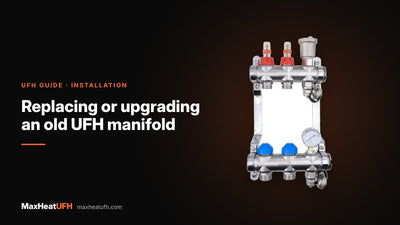
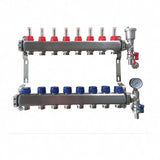
- On the manifold end unit. Many manifolds carry a pressure gauge end unit on one bar, often paired with an auto air vent and drain valve on the other. This reads the UFH circuit itself.
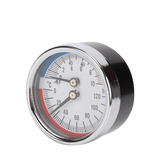
- On the mixing unit. Blending valve pump packs often take a combined pressure and temperature gauge, which also shows the mixed flow temperature going to the floor.
- On the boiler or heat pump. On a directly connected sealed system, the appliance gauge and the manifold gauge are reading the same body of water, so they should broadly agree.
If your manifold has no gauge, one screws into a spare end-unit port in minutes on a Dualmix manifold or most other 1" manifolds.
What pressure should underfloor heating run at?
The same as the rest of a sealed heating system, because it is the same water. Consumer guidance from Which? puts normal operating pressure between 1 and 2 bar, with the gauge typically reading around 1 to 1.5 bar when the heating is off and cold. Below about 1 bar, boilers commonly lock out or lose performance; above 2 bar, the system is carrying more water than it needs.
| Gauge reading | Meaning | Action |
|---|---|---|
| 1 to 1.5 bar cold | Normal | None |
| Up to ~2 bar hot | Normal expansion | None |
| Below 1 bar | Underfilled or losing water | Top up; watch for a repeat fall |
| Above 2 bar | Overfilled or filling loop passing | Bleed down; check filling loop is shut |
| 0 bar | Empty or gauge isolated/failed | Investigate before running the pump |
The UFH pipework itself has headroom above all of this: PE-RT and multilayer heating pipe is rated to a maximum working pressure of 6 bar at heating temperatures, with a design maximum of 70°C, so normal system pressures stress it very little.
Why does the needle rise when the heating runs?
Water expands as it heats, and in a sealed system that expansion has nowhere to go except into the expansion vessel, compressing its air cushion and nudging the gauge up. A rise of a fraction of a bar from cold to hot is normal and repeats identically every cycle.
Watch the pattern rather than the number. A healthy system draws the same arc every day: cold reading, gentle rise, back to the same cold reading. Two patterns break it:
- Sharp swings from cold to high pressure, sometimes with water at the boiler's relief pipe, usually mean the expansion vessel has lost its air charge and needs repressurising or replacing.
- A cold reading that is a little lower every week means water is leaving the system somewhere.
What should the gauge read during a pressure test?
Far higher than running pressure, because the test's job is to find weaknesses before the screed hides the pipe. A typical UK manufacturer specification: fill with water, vent all air, raise to 6 bar, hold for 60 minutes, inspect every joint, and record the result on a test certificate. The system is then kept under pressure while the screed is laid, so that any damage from the screeding work shows instantly as a falling needle.
Three practical points for reading the test:
- Vent first. Trapped air compresses, so an airy system can hold a deceptively steady needle and then creep as the air dissolves. The test is only valid on a purged system.
- Expect small temperature effects. A test rig left overnight will read differently on a cold morning; judge the hold over the specified period at a stable temperature.
- Test loop by loop if it fails. Isolate circuits at the manifold and retest to corner the leak.
The full procedure, including testing with air where water is not practical, is in our guide to pressure testing underfloor heating.
Why is my underfloor heating pressure dropping?
Because water is escaping, or occasionally because air is leaving. Fresh systems often need a top-up or two in the first weeks as dissolved air comes out at the auto air vents; that is benign and self-limiting. A fall that keeps returning after that points, in rough order of likelihood, to:
- weeping manifold connections, actuator valve glands or Eurocone nuts, see manifold leaking;
- a passing pressure relief valve on the boiler, discharging outside unnoticed;
- a leak on radiators, cylinder coils or primary pipework elsewhere on the same sealed system;
- rarely, a damaged floor pipe, which usually announces itself after drilling or screwing into the floor.
Work through the checks in UFH pressure dropping before suspecting the buried pipe; in practice the floor loops, with no joints under the screed, are the last place a sealed system leaks.
Why is the pressure too high?
Three causes cover nearly every case. The filling loop was left cracked open, so mains pressure is slowly charging the system. The system was simply overfilled at the last top-up. Or the expansion vessel's charge has failed, so heating swings the pressure high rather than the standing pressure being high. Bleeding a little water out at a radiator or the manifold drain valve brings the standing pressure down; if it climbs again with the filling loop shut, the fault is the vessel or a passing fill valve, not your top-up technique.
Persistent overpressure matters because the boiler's relief valve will dump water every cycle, and every refill brings fresh, oxygenated water into the system, which is exactly what inhibitor and oxygen-barrier pipe are there to avoid.
Does air in the system show on the gauge?
Indirectly. Air pockets make the pressure respond strangely: readings that bounce as the pump starts and stops, pressure that falls after the auto air vent has been working, and loops that gurgle while the gauge looks normal. The gauge measures the water; it cannot see where the air is sitting.
If the gauge behaviour is odd and the floor is patchy, purge before chasing phantom leaks: our guide to bleeding air out of underfloor heating covers it loop by loop. Top up to the normal cold pressure afterwards, since vented air always leaves the pressure a little lower.
Design your UFH system yourself in 3 minutes with MaxHeatUFH ProLoop and get an instant quick design and quote. Start your design
Frequently asked questions
What pressure should my underfloor heating be?
On a sealed system, about 1 to 1.5 bar cold and between 1 and 2 bar in normal operation, the same as the boiler it shares water with. Check your appliance manual for its preferred figure.
What pressure is underfloor heating pipe tested to?
A common manufacturer specification is 6 bar held for 60 minutes with water before the screed goes in, with the system left under pressure during screeding. The pipe itself is rated to 6 bar maximum working pressure, so the test exercises it to its rating, well above anything it sees in service.
Is it normal for the pressure to change between hot and cold?
Yes. Expect a modest, repeatable rise as the system heats and the water expands into the expansion vessel. Large swings, or pressure that ratchets upward or downward day on day, are the readings worth investigating.
My manifold gauge and boiler gauge disagree. Which is right?
On a directly connected sealed system they read the same water and should roughly agree; small differences come from gauge height and tolerance. A large disagreement usually means one gauge has failed, commonly the cheaper one, or a valve between them is shut.
Can I run underfloor heating at 3 bar to get more heat?
No, and it would not help. Heat output comes from water temperature and flow, not static pressure. Most sealed systems relieve not far above normal operating pressure, so running high just exercises the relief valve and wastes inhibitor with every refill.
How often should I need to top up the pressure?
Rarely, once the system has settled. A new system may need a couple of top-ups as air vents out. An established system that needs topping up more than a couple of times a year is losing water and worth investigating.
What does a pressure gauge on the mixing unit show?
Combined gauges show the circuit pressure and the mixed flow temperature leaving the blending valve, so one dial confirms both that the system is full and that the floor is being fed at its design temperature.
Products in this guide
Watch how each part works and how to fit it, and download its data sheet and install manual.



Every data sheet and manual: Product Library · All videos: MaxHeatUFH on YouTube

Design it in MaxHeatUFH ProLoop
Add your rooms, choose screed, overlay, joisted or electric, and get a free quick design and full kit list with prices.