Do you need underfloor heating in a Passivhaus or very low-energy home?
How small Passivhaus heating loads are, the pros and cons of underfloor heating at 10W/m², the alternatives, and how to design and control low-temperature underfloor heating so it does not overheat.
Short answer: No, a Passivhaus does not need underfloor heating, and many are heated with a few small radiators or even through the ventilation air. A certified Passive House has a peak heating load of about 10W/m² or an annual heating demand of no more than 15kWh/m². Underfloor heating still works well in a Passivhaus or very low-energy home if you want warm floors, but it must be designed for that tiny load and run at low temperature with careful control, or it can overheat the rooms.
Underfloor heating is often sold as the natural choice for a modern, efficient home. In a Passivhaus, or any home built close to that standard, the picture is different. The fabric and airtightness are so good that the heating system becomes small, and the main question is not how much heat you need but how to deliver a little heat without overshooting.
This guide explains how small Passivhaus heating loads are, the pros and cons of underfloor heating at that level, the alternatives, how to design and control underfloor heating if you choose it, and where it makes most sense, such as bathrooms. It also applies to low-energy homes built to a high fabric standard without formal certification.
How much heating does a Passivhaus need?
Very little. The Passive House Institute sets two alternative heating criteria, and a building can meet either.
| Criterion | Passive House limit | What it means |
|---|---|---|
| Annual heating demand | 15kWh/m² per year or less | Total heat needed over a year |
| Peak heating load | About 10W/m² | Heat needed on the coldest day |
The 10W/m² figure comes from how much heat the fresh air supply can carry. The Institute notes that supply air can only be heated by about 30K, to around 51°C, before dust starts to scorch. That limits air heating to about 10W/m² of living area. If the peak load stays within that, a Passivhaus can in theory be heated through the ventilation alone, perhaps with a small extra heater in the bathroom.
To put 10W/m² in context: one maker's published output for a screeded underfloor heating system is 76W/m² at 200mm pipe centres with a 50°C mean water temperature. A Passivhaus needs a small fraction of what a normal underfloor heating system is designed to give.
Is underfloor heating a good idea in a Passivhaus?
It can be, but it is rarely the cheapest or simplest option. The Passivhaus Trust's guidance on building services says underfloor heating "certainly works in a Passivhaus" but also lists the drawbacks.
| For | Against |
|---|---|
| Self-limiting if the floor is kept only a degree or two above room temperature | Can be an expensive option, as it must go in every room you want warm |
| Very low flow temperatures with a heat pump, usually under 30°C | Can be too powerful for the heat load |
| No mixing valves needed on a heat pump system | Needs careful control to avoid overheating |
| Warm floors and no wall-mounted heaters | Radiators are a cheaper match for most Passivhaus homes |
The self-limiting effect is the key. When the floor is only slightly warmer than the room, its heat output falls as the room warms from sunshine, people or cooking, and stops if the room reaches floor temperature. That only works if the system runs at a very low flow temperature. Run it like a normal underfloor heating system and the room will overheat.
What are the alternatives to underfloor heating in a low-energy home?
There are three common options, and the Passivhaus Trust guidance favours the simpler ones on cost.
- Radiators with a heat pump. The Trust calls radiators a cheap heating system that is "an excellent match for a Passivhaus." With triple glazing there are no downdraughts, so radiators can go anywhere in a room, and TRVs give room-by-room control. Sized for heat pump temperatures, ideally below 40°C, they still stay small because the load is low.
- Air-to-air heat pumps. The Trust says some Passivhaus buildings suit air-to-air split systems, which are cheaper still. In one project it describes, a 2.5kW mini-split was enough to heat the whole building.
- Direct electric heaters. Where the load is tiny, such as the 500W per flat in one example, small electric panel heaters can be used. Running cost matters: electricity is 26.32p/kWh under the October 2026 price cap, against 7.97p/kWh for gas.
The Trust also notes that air source heat pumps with radiators are usually the rational choice over ground source heat pumps with underfloor heating, which are a little more efficient but cost more to install. Our guide to underfloor heating vs radiators compares the two in normal homes.
How do I design underfloor heating for a Passivhaus?
Design it for the real heat load, then aim for the lowest flow temperature that meets it. A standard rule-of-thumb design will be badly oversized.
- Use the PHPP or a room-by-room model. The Passivhaus Trust advises a room-by-room steady-state calculation that includes the real airtightness and MVHR, not default ventilation rates. Its example: 0.5 air changes per hour with 90% heat recovery is effectively 0.05 air changes per hour for heat loss. See our heat loss calculation guide.
- Choose the floor system for response. A low-mass system, such as a low-profile overlay board, reacts faster to solar gain than a thick screed. A screed system adds thermal mass, which some designers use to smooth out temperatures. Read thermal mass and underfloor heating before you choose.
- Wider pipe centres are often enough. With such low heat loss, 200mm centres usually give more than enough output at a low water temperature.
- Size the heat pump to the building. The Trust warns that even the smallest heat pumps can have more output than a Passivhaus needs. The emitters must be able to absorb the heat pump's minimum output.
- Skip the mixing valve on a heat pump. A heat pump can supply water at underfloor heating temperature directly, so a non-mixing pump set such as our pre-assembled non-mixing pump set is the usual choice. See non-mixing pump sets for heat pumps.
Use a good oxygen barrier pipe, such as our PERT-EVOH pipe, with every loop to 100m or less.
How should underfloor heating be controlled in a Passivhaus?
Run it continuously at a low, steady temperature, and let the room temperature limit it. The Passivhaus Trust notes that continuous heating suits heat pumps, and the small overnight temperature drop in a Passivhaus means there is minimal penalty for heating continuously.
- Low flow temperature first. Set the heat pump or weather compensation so the floor is only just warmer than the room. This is what makes the floor self-limiting.
- Thermostats as a ceiling, not an on-off switch. Room thermostats such as the Heatmiser neoStat V3 stop rooms overshooting on sunny days. Building Regulations guidance expects thermostatic room controls for each room in a new system, with zone control in some open-plan cases.
- No big setbacks. Deep night setbacks gain little in a building that barely cools down, and a slow floor can then overshoot in the morning.
Where does underfloor heating make most sense in a low-energy home?
In bathrooms and anywhere you value warm floors for comfort. Even the Passive House Institute allows that a small extra heater may be needed in the bathroom, where people expect a warmer room and bare feet are on the floor.
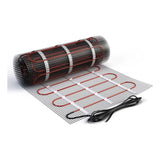
- Bathrooms and en-suites. A small water loop or an electric mat under tiles gives warm floors. A low-output mat such as a MaxHeatUFH 100W/m² electric mat on a thermostat with a floor probe is a sensible choice where the mat is there for floor comfort rather than as the main heating. The final connection must be made by a qualified electrician.
- Ground floor living areas with tiled or stone floors, where a cold hard floor would feel uncomfortable even if the air is warm.
- Homes built to a good, but not Passivhaus, standard. As the heat load rises above about 10W/m², underfloor heating's advantages over radiators start to matter more.
Design your UFH system yourself in 3 minutes with MaxHeatUFH ProLoop and get an instant quick design and quote. For a Passivhaus, check its suggestions against your PHPP heat load. Start your design
Frequently asked questions
Do Passivhaus homes have central heating?
Most have some heating, but it is small. Options include a few radiators on a heat pump, an air-to-air heat pump, heating through the MVHR supply air, small electric heaters or low-temperature underfloor heating.
Can a Passivhaus be heated by MVHR alone?
In theory, if the peak heating load is within about 10W/m², since that is what supply air can carry. The Passivhaus Trust notes that this is possible but not always the best way, because supply air and heat demand are often in different places.
Will underfloor heating overheat a Passivhaus?
It can if it is designed and run like a normal system. Keep the flow temperature low so the floor is only a degree or two above room temperature, and use room thermostats to stop overshoot on sunny days.
What flow temperature does underfloor heating need in a Passivhaus?
Very low. The Passivhaus Trust says flow temperatures with a heat pump are usually less than 30°C, depending on the floor construction and coverings.
Is underfloor heating worth it in a low-energy new build?
It depends on what you value. Radiators are usually cheaper to fit in a very low-energy home. Underfloor heating gives warm floors and clear walls. In a home with a higher heat load, the case for underfloor heating gets stronger.
Do I need a mixing valve for underfloor heating with a heat pump?
Usually not. A heat pump can produce water at the right temperature for the floor, so a non-mixing pump set is used.
Does MaxHeatUFH supply kits for Passivhaus projects?
Yes. MaxHeatUFH supplies water and electric underfloor heating kits with next working day UK delivery on orders placed by 12pm, Monday to Friday. MaxHeatUFH does not install, but passes installs to vetted, approved installers.
Sources: Passipedia (Passive House Institute): heating load, Passivhaus Trust: How to Build, chapter 8 (services), Approved Document L volume 1, Ofgem energy price cap
Products in this guide
Watch how each part works and how to fit it, and download its data sheet and install manual.




Every data sheet and manual: Product Library · All videos: MaxHeatUFH on YouTube

Design it in MaxHeatUFH ProLoop
Add your rooms, choose screed, overlay, joisted or electric, and get a free quick design and full kit list with prices.