

Underfloor cooling: can UFH cool your home with a reversible heat pump?
How water underfloor heating can cool a home with a reversible heat pump: cooling output, dew point and condensation control, what you need and the grant rules.
Short answer: Yes, water underfloor heating can cool a home if it is fed with chilled water from a reversible heat pump, but the effect is gentle. Makers quote a room 2 to 5°C cooler than it would otherwise be, and one maker's floor cooling outputs run from about 23 to 37W/m², about a third of heating output. It needs a humidity sensor and dew point control so the floor never gets cold enough for condensation. Electric UFH and gas boilers cannot cool.
Hot summers have made cooling a real question for UK homes, especially new builds with large glazing and extensions with roof lights. If you are already fitting wet underfloor heating with an air source or ground source heat pump, the same pipes in the floor can do a second job. Instead of warm water, the heat pump sends cool water through the loops, and the floor soaks up heat from the room.
This guide explains how underfloor cooling works, how much it can do, the condensation risk and how to control it, what you need at the manifold and thermostats, and how it fits with the Boiler Upgrade Scheme. For the heating side, see our guide to underfloor heating with a heat pump.
Can underfloor heating cool a house?
Yes, a wet system can, as long as the heat source can make chilled water. Chilled water runs through the same UFH pipes and absorbs heat from the room through the floor surface. This is often called radiant cooling.
| System | Can it cool? | Why |
|---|---|---|
| Water UFH with a reversible heat pump | Yes | The heat pump can supply cool water to the loops |
| Water UFH with a gas or oil boiler | No | A boiler only makes heat |
| Electric mats or cable | No | No pipework to carry heat away |
It is not air conditioning. It does not blow cold air and it does not dry the air the way an air conditioner does. Heat pump specialists describe it as a way to take the edge off hot weather over time rather than to cool a very hot room quickly.
How much cooling does underfloor cooling give?
Much less than the same floor gives in heating. One maker's published figures for 16mm pipe in screed, at an 8K difference between the room and the cooling water, show cooling outputs from about 23 to 37W/m², depending on pipe centres and screed depth.
| Pipe centres | 35mm screed over pipe | 65mm screed over pipe |
|---|---|---|
| 100mm | 36.7W/m² | 32.3W/m² |
| 150mm | 32.6W/m² | 29.0W/m² |
| 200mm | 29.0W/m² | 26.1W/m² |
| 250mm | 25.8W/m² | 23.5W/m² |
The same document gives heating outputs of around 70 to 100W/m² for the same floor. So a floor that heats a room comfortably in winter gives roughly a third of that as cooling. In practice, makers quote rooms 2 to 3°C cooler, and one radiator and UFH maker quotes 3 to 5°C compared with an uncooled room. Air conditioning can lower a room much further.
The pattern for design is the same as heating: closer pipe and a thinner layer over the pipe give more output. If cooling matters to you, that is another reason to choose 100 or 150mm centres. See UFH pipe centres: 100, 150 or 200mm.
What is the condensation risk with underfloor cooling?
If the floor gets colder than the dew point of the room air, moisture from the air condenses on it, and wet floors are exactly what you do not want. Every underfloor cooling system needs controls that keep the floor safely above the dew point.
The dew point depends on the room temperature and humidity, so it changes through the day. That is why the cooling water temperature cannot simply be set and left:
- Humidity sensing is required. One UFH maker states that in cooling mode the supply water temperature depends on the dew point, so a humidity sensor has to be installed.
- Sense the right room. A humidity sensor on the manifold in a humid plant room can shut cooling down early. A reference room is better.
- Add a floor limit. Per-room floor sensors can hold a minimum floor temperature of about 18 to 20°C. They measure the surface, not the dew point, so they back up the humidity sensor rather than replace it.
- Fit a dew point sensor on the supply. Strap-on dew point sensors are made for the manifold supply pipe and act as protection against condensation.
Cooling supply water is usually much warmer than air conditioning water. One combined heating and cooling system lists 15 to 20°C supply water for cooling, which must also stay above the dew point. Do not run very cold water through the floor to get more output.
What do you need to add underfloor cooling to a UFH system?
A reversible heat pump, a properly designed wet floor, controls that can switch between heating and cooling, and dew point protection. The parts in the floor are the same as for heating.
- Heat pump with cooling mode. Check the heat pump is reversible and that cooling is enabled and set up by the installer.
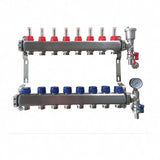
- Manifold set-up for a heat pump. Heat pump systems usually run the manifold on a non-mixing pump set, so the heat pump sets the water temperature in both modes. A thermostatic blending valve rated 20 to 55°C is a heating device and is not used to control cooling. See non-mixing pump sets for heat pumps.
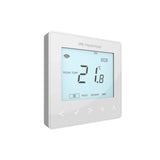
- Heating and cooling thermostats. Room thermostats need a cooling mode and must tell the system which rooms want cooling. Heatmiser lists a neoStat-HC heating and cooling thermostat as compatible with its neoHub.
- Humidity and dew point control, as above, so the cooling water temperature follows the room conditions.
- Cooling-aware design. Room by room, check the cooling load against the floor's cooling output, not only the heat loss.
Pipes and fittings outside the floor will carry cool water in summer, so any part of the system in a warm, humid space can sweat. Ask your installer how the pipework to the manifold will be insulated.
Which floor finishes work best for underfloor cooling?
Tiles and stone work best. They pass heat well, so the floor can absorb more heat from the room. Thick carpets and heavy rugs act like insulation and cut the effect, and a lot of furniture covering the floor does the same.
The rules that suit underfloor heating suit cooling too: a low-tog finish, nothing bulky covering large areas of floor, and a floor probe where the finish has a temperature limit. See UFH under tiles, LVT, laminate, wood and carpet.
Is underfloor cooling worth it in the UK?
It is worth it as an add-on if you are fitting wet UFH with a heat pump anyway, especially in rooms that overheat in summer. It is rarely worth it as the main reason to fit UFH, and it will not match air conditioning on a very hot, humid day.
- Best fit: well-insulated homes, rooms with large glazing, south-facing extensions, and tiled floors.
- Cut the heat gain first: close blinds before the sun reaches the glass, use external shading where you can, and ventilate when the outside air is cooler.
- Get it designed: cooling needs proper design and dew point controls, and heat pump specialists say it should not be treated as a DIY hack.
Does the Boiler Upgrade Scheme cover a heat pump that also cools?
A heat pump maker's installer guide to the scheme says any air-to-water heat pump system is eligible, and extra functions such as cooling are also permitted, as long as the system fully meets the property's space heating and hot water demand. Check the current rules with Ofgem before relying on this for a specific job.
| Technology | Grant (England and Wales) |
|---|---|
| Air source (air-to-water) heat pump | £7500 |
| Ground source heat pump | £7500 |
| Air-to-air heat pump (homes only, from 28 April 2026) | £2500 |
The grant is claimed by an MCS-certified installer and passed to you as a discount. Scotland is not covered and has its own scheme. Ofgem's guidance says the scheme now runs to 2030, and that uplifted grants for eligible off-gas grid homes are available from 21 July 2026.
On VAT: 0% VAT on energy-saving materials applies only when a qualifying installer supplies and installs a qualifying measure. If you buy UFH kit supply-only from a merchant, including MaxHeatUFH, it carries 20% VAT. Check gov.uk for the current rules. MaxHeatUFH does not install, but we can pass your job to a vetted approved installer through our installation enquiry.
Design your UFH system yourself in 3 minutes with MaxHeatUFH ProLoop and get an instant quick design and quote. Start your design
Frequently asked questions
Can underfloor heating be used for cooling?
Yes, if it is a wet system fed by a reversible heat pump. Electric UFH and boiler-fed systems cannot cool.
How much cooler will underfloor cooling make a room?
Makers quote around 2 to 5°C cooler than an uncooled room. Air conditioning can lower the temperature much further.
Does underfloor cooling cause condensation?
It can if the floor drops below the dew point. Humidity sensing and dew point control keep the water and floor temperature above that point.
Does underfloor cooling remove humidity?
No. Unlike air conditioning, it does not dry the air. That is also why it must be controlled to stay above the dew point.
Can I add cooling to my existing underfloor heating?
Only if you have, or fit, a heat pump with cooling mode, plus heating and cooling thermostats and dew point protection. An installer should check the floor's cooling output for each room.
What water temperature is used for underfloor cooling?
One combined system lists 15 to 20°C supply water for cooling, always above the dew point. The controls adjust it to the room humidity.
Does pipe spacing matter for cooling?
Yes. Closer centres give more cooling output. One maker's figures show about 33W/m² at 150mm against 26W/m² at 250mm, in the same screed.
Sources: Livingetc: how to cool a home with underfloor heating, InstallerSHOW: heat and cool UFH system, Heatmiser neoHub compatibility, Ofgem: BUS guidance for installers v5 updates, Ofgem: BUS guidance for property owners
Products in this guide
Watch how each part works and how to fit it, and download its data sheet and install manual.



Every data sheet and manual: Product Library · All videos: MaxHeatUFH on YouTube

Design it in MaxHeatUFH ProLoop
Add your rooms, choose screed, overlay, joisted or electric, and get a free quick design and full kit list with prices.