

Which copper press tool should installers buy? Cordless vs manual, hire vs buy
How to choose a press tool for copper M-press fittings: compact vs 32kN tools, cordless vs manual, matching jaws, hire vs buy costs and servicing.
Short answer: For copper M-press fittings, most heating installers are best served by a battery press tool that takes M-profile jaws and is on the fitting maker's approved tool list. A compact tool covers 12 to 35mm; a standard 32kN tool covers up to 54mm with collars. Hire makes sense for one job or a few weeks a year: one UK hire firm lists a cordless 15 to 35mm press tool at £108 a week inc VAT. If you press copper most weeks, buying pays back quickly.
Press fittings have changed how a lot of heating work is done. There is no flame, no flux, no waiting for joints to cool, and a good joint takes seconds. But the tool is the expensive part. A press joint is only as good as the tool and jaw that made it, and fitting makers only stand behind joints made with tools and jaws they approve.
This guide covers the main tool types, how to match tool and jaw to the fitting, when to hire and when to buy, and how to look after the tool so it keeps making sound joints. For the wider choice between joining methods, see copper press fittings vs solder vs compression.
What types of copper press tool are there?
There are two main classes for copper: compact tools of about 19kN, and standard tools of 32kN. Both are usually battery powered. The difference is size range, weight and reach.
| Tool class | Copper sizes | Best for |
|---|---|---|
| Compact (about 19kN) | 12 to 35mm | Domestic heating, tight spaces, one-handed work |
| Standard (32kN), jaws | 15 to 35mm | Daily domestic and light commercial work |
| Standard (32kN), collars or rings with adapter | 42 to 54mm | Plant rooms, larger heating mains |
These ranges come from a major copper fitting maker's tool compatibility chart. It lists approved compact machines for 12 to 35mm and approved standard 32kN machines for 12 to 54mm, with 42 and 54mm made using collars or rings and an adapter jaw. Another fitting maker states that tools used up to 54mm should give at least 30kN of pressing force, and that force above roughly 34kN can damage the jaws.
For most UFH and boiler work, 15, 22 and 28mm are the sizes that matter. A compact or standard tool both cover those. You only need the bigger set-up if you regularly work in 35mm and above.
Cordless or manual: which press tool should you buy for copper?
For copper, buy cordless. The approved tool lists published by copper press fitting makers are made up of powered machines. Before using any manual tool on copper, check that the fitting maker approves that tool and jaw. If they do not, the joint may not be covered by their warranty.
Manual press tools make more sense for multilayer pipe. Our Manual Pressing Clamp Tool Set presses U-profile MLCP fittings from 16 to 32mm with no battery, but it will not press copper. Copper M-press fittings need M-profile jaws on a powered tool.
- Cordless suits you if you press copper every week, work in cupboards and ceiling voids, or need 28mm and above.
- Manual suits you if the job is mainly 16mm and 20mm multilayer, such as UFH manifold tails or radiator drops, and you want a light, cheap back-up tool.
- A dual-profile cordless tool suits you if you do both. One battery body with M jaws for copper and U jaws for multilayer saves carrying two tools.
Which jaws do copper press fittings need?
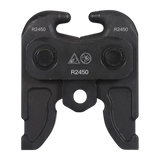
Use the jaw profile and size the fitting maker specifies, on a tool they list for it. Copper M-press fittings take M-profile jaws. Multilayer fittings use a different profile, such as U-profile, so the same jaw will not do both.
Fitting makers are clear on three points: use only the jaw that matches the fitting size and the tool's listed jaw profile, place it square on the fitting with the bead central in the jaw groove, and confirm tool-to-jaw compatibility with the maker. Jaws from one tool family do not always fit another, even when the profile is the same. Our guide to M-profile vs U-profile press jaws explains the shapes.
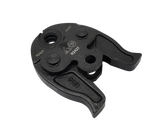
Angled jaws are worth adding if you work close to walls, joists or other pipes. They reach fittings a straight jaw cannot. Our M-profile angled jaws are made for our High Power tool (MH-HPEHCS).
Should you hire or buy a press tool?
Hire for a one-off job, buy if you press most weeks. Here is how the two compare:
| Option | What you get |
|---|---|
| Hire, cordless 15 to 35mm | Tool, 2 batteries and charger; deposit and ID needed |
| Buy: MaxHeatUFH Electric Hydraulic Press Tool Set | Tool, 2 batteries and charger; jaws bought separately |
| Jaws: M-profile or U-profile | One jaw per size you work in |
One UK hire firm charges £108 per week inc VAT for a cordless 15 to 35mm press tool. Compare that with the tool price on its product page, and add the jaws you need. If you expect to press copper for more than a couple of months a year, buying usually wins, and you have the tool on the van when a callout needs it.
Hire has its own costs to check: deposits, damage waivers, delivery and collection charges, and whether the hired tool comes with the jaws you need. Check too that the hire tool and its jaws are on the approved list for the fittings you are using.
What should a press tool for UFH and heating work cover?
For most installers, 15, 22 and 28mm copper plus 16 and 20mm multilayer. That covers boiler and heat pump connections, primary pipework to the manifold and the manifold tails themselves.
The MaxHeatUFH Electric Hydraulic Press Tool Set (MH-EHCS) takes M-profile jaws for 15 to 28mm copper and U-profile jaws for 16 to 32mm multilayer, so one battery tool does both. Our 35, 42 and 54mm M-profile jaws fit the High Power tool (MH-HPEHCS) only, so if you need larger copper, ask us at sales@maxheatufh.com which set-up suits your work.
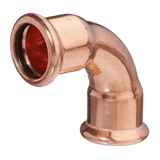
For the fittings themselves, see our copper M-press fittings and MLCP press fittings.
How do you make a press joint that will pass the test?
Cut square, deburr, mark the depth, insert fully and press once. Fitting maker instructions for copper press fittings set out these steps:
- Check the tube. Use copper tube to EN 1057. Hard, half-hard and soft tube can be used, within the maker's wall thickness limits.
- Cut square with a rotary tube cutter, not a hacksaw.
- Deburr inside and outside and check the tube end is round and free of deep scratches.
- Mark the insertion depth. For example, one maker gives 23mm for 22mm tube.
- Check the O-ring is present and seated, then push the tube in fully to the tube stop. Turning it slightly as you push helps avoid moving the O-ring.
- Press once with the correct jaw, held square. Do not re-press a joint.
- Mark the joint as pressed so it is easy to check before testing.
Most copper press fittings have a leak-before-press feature: an unpressed joint leaks at low test pressure so you can find it. One maker's figure is a noticeable leak between 0.1 and 6.0 bar. Test first at 1 to 2 bar and look for leaks, press any you missed, then raise to the full test pressure. For UFH loops and manifolds, follow our guide to pressure testing underfloor heating.
How often does a press tool need servicing?
At least once a year unless the tool maker gives another interval, and jaws should be checked after every use. Makers set intervals by time or by number of presses:
- One fitting and tool maker says press machines and jaws should be serviced at least once a year where no other interval is given, and that yearly servicing extends its own machines' warranty to three years.
- Another sets jaw and ring servicing at every two years, and its machines flag a service after 20,000 to 40,000 presses depending on model.
- The hire tool above lists a service interval of 32,000 cycles.
Day to day, clean the jaw contours with a fine cleaning fleece to remove deposits, oil the hinges and moving parts, and store the tool clean and dry. Check the jaw contours for wear or damage after each job, and make a test press if you are unsure. Replace worn or deformed jaws rather than carrying on with them.
Design your UFH system yourself in 3 minutes with MaxHeatUFH ProLoop and get an instant quick design and quote. Start your design
Frequently asked questions
What size press tool do I need for domestic heating?
A tool that covers 15, 22 and 28mm copper suits most domestic heating. Add multilayer jaws if you also press UFH manifold tails or radiator drops.
Can I use one press tool for copper and multilayer?
Yes, if the tool takes both jaw types. The MaxHeatUFH Electric Hydraulic Press Tool Set takes M-profile jaws for copper and U-profile jaws for multilayer.
Can a manual press tool press copper fittings?
Only if the fitting maker approves that tool and jaw. The approved lists published by copper fitting makers are powered tools. Our manual tool set is for U-profile multilayer fittings only.
How much does it cost to hire a press tool?
One UK hire firm lists a cordless 15 to 35mm press tool at £108 per week inc VAT, with two batteries and a charger, plus a refundable deposit. Prices vary by firm and location.
Can I re-press a joint that was not pressed properly?
Fitting makers say press each joint once only. An unpressed joint found at low test pressure can be pressed, but only if the tube is still fully inserted to the stop.
Do I need different jaws for different brands of fitting?
You need the profile and tool the fitting maker approves. Many copper fittings use M-profile, but always check the maker's tool and jaw compatibility list.
How long does a press tool last?
Makers set service intervals rather than a fixed life: typically a yearly service, or a service flag after 20,000 to 40,000 presses depending on the model. Keep to those intervals and replace worn jaws.
Products in this guide
Watch how each part works and how to fit it, and download its data sheet and install manual.





Every data sheet and manual: Product Library · All videos: MaxHeatUFH on YouTube
Design it in MaxHeatUFH ProLoop
Add your rooms, choose screed, overlay, joisted or electric, and get a free quick design and full kit list with prices.